 Skip to content
Have you ever wondered why some people just have the best ideas, if anywhere, a product flops, a project fails, or a campaign in the pants? My Thesis is: Innovation stems from not only the forward travel, but often the response. This is precisely the small, under-appreciated secret of Reverse Engineering: You know what is wrong and build on it a little Better.
Why the better teachers often Fail is
We love success stories. They are colorful, engaging, and good to Share. But the really exciting lessons are usually where something not worked. In Business, start-UPS, in projects and in everyday life. If you want to learn how you can systematically success and Failure to learn, have a look at my article "From the success and failure of learning: How did your Association's goals properly evaluate can" to. There, I'll make it clear that the bad results are not amortized, but must be evaluated, in order to show you the next stage.
Imagine that you could see why a competitor has failed, and you don't have at the end of an advantage, because you get the error again. Or better yet, You find an obvious flaw in a product or a service, and the materials right there in your own unique characteristic. This is not a plea for a Copy, but for the targeted, analytical "Dissect" solutions – just Reverse Engineering in the context of strategy, product development and creativity.
It is interesting to note that this way of Thinking works, not only technically, but also mentally and culturally. Anyone that works within the Team to be open with errors, gaining faster insights. Who's hiding in contrast, the error remains irrational on Existing slopes. In my article on the topic "The art of failure in a global comparison: Why some cultures celebrate failure, and other punish" I show how a clear error of culture route to Innovation is paving.
What is Reverse Engineering in the Business really brings

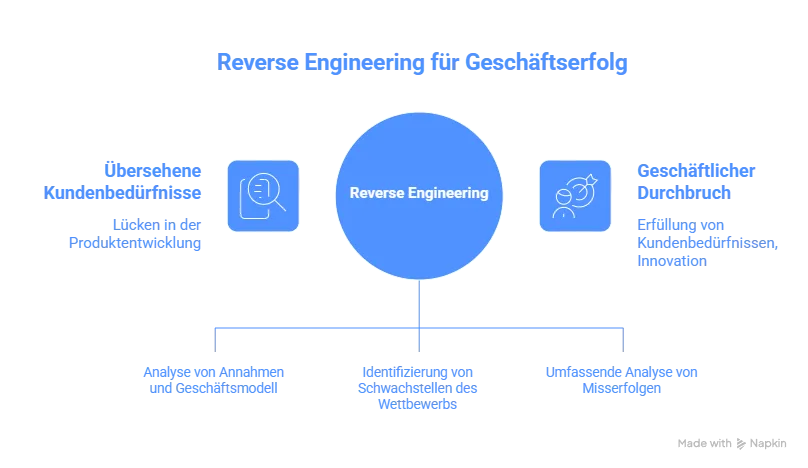
Reverse Engineering, for the purposes of this article, means: cutting up a solution thoughts in your components. You're not gonna see the end product, but also the assumptions that communication, the business model and the user experience behind her.
This can be a concrete product, a service, a campaign, or an entire business model. Particularly valuable it is, if you not only the success of the competition look, but specifically the failed attempts. Because that's where the unspoken gaps, which often prove to be a door to your own breakthrough are.
What do you see as:
- Which customers have been overlooked needs?
- What are the functions were unnecessarily complex or simply too confusing?
- What are the assumptions on the market have not been checked?
- Where has brakes, the competition itself – due to too much complexity, price, market positioning and Design?
Right here you profitiertst if you look at ideas on a Macro‑, Meso‑ and micro-level. In my post "Macro‑, Meso‑ and micro-level, the idea of development" I explain why you can't be a failure event on a level, break it down. If you look only at the "price" or "technically", you will see most of the half truth.
A practical step-by-step approach
If you connect to the Reverse Engineering in the everyday life with a clear Format, it will be implemented immediately. This does not help you, to learn from mistakes of others, but it concrete next steps to derive. In this process, fits excellent, by the way to my post "Idea muscle training: creativity boosting" – because that is where it comes from exactly such a "error‑Stories" a reliable reservoir of ideas.
1. The "autopsy" begins to Gather and Observe
A Detective of your market.
So many information to gather as possible about the failure of the product, the failure of the service or the weak solution of your Competitor. This can be customer reviews, press releases, market analysis, or even Social Media comments.
Ask Yourself:
- What was promised?
- What is actually received by the customer?
- Where arises when Users of Frustration?
- What are the recurring patterns in the reviews you see?
A practical tip:
Take a look at Google Play reviews, App Store Reviews or Amazon reviews carefully. What is there, is not a coincidence – it is a living, blunt Feedback, which you can use for free. If you learn of problems such as a nut paste Buntings, it helps you to the article "To solve problems – the nut even crack" with clear questions, deep into the Problem to be immersed.
2. The anatomy of failure: causes research
Now it gets exciting: Why it did not work?
It was a technical Problem? A wrong marketing strategy? Too high a price? Inappropriate targeting? Or a Combination of several factors?
Here, a systematic, multi-step procedure helps.
- A SWOT analysis from the perspective of the failed project can help you to sort Strengths, Weaknesses, Opportunities and Threats in a systematic way.
- You can use the 5‑Why approach to the bottom of the ditch: "Why?... And why?...“ – until you end up at the real core at the symptom level.
Methods for the in-depth research into the causes can be found in my article "Creativity through limitation: How Constraints of your best ideas, free" – here I show, how you inferred from the restrictions exactly the right questions, instead of simply giving up.
3. Reverse: How do I make it better?
If you have understood, why something went wrong, you can turn the tables:
You don't understand the error, not as a defeat but as a default, and know what you're in your own project avoid or improve can.
Some of the lever, which will help you to immediately:
- Club times the support or the Customer Journey.
- Reducing unnecessary complexity, instead of still more functions on it to download.
- Oblique your use of the promise of even more clear.
- Check your Marktanahmen early with real conversations, instead of theory.
- Build early prototypes to test with Users like you in the post "Design Thinking: An innovative approach to problem solving" see.

A practical example:
Imagine a competitor brings a Smart Home System on the market, and the flops due to the lack of compatibility with other devices. Users are upset that "the System works only with yourself".
Your Conclusion?
You develop a System that focused on open Standards, broad compatibility, and a clear user guidance. And not only technologically, but also strategically embedded in a clear vision of the future. In my post "Vision of the future to develop: a guide with Exercises" you will see how such a vision issues in your project, integrate.
4. The blueprint for success: Innovation to develop
Run from your insights, practical ideas and solution approaches.
This can be a completely new product, is the visible development of an existing service, or a completely different type of market communication.
The trick is: You start not with "zero", but on the Foundation of the experience, and is also the fault of others.
Internal Link:
- Methods such as you find such ideas in a structured and sort them can be found in my article "The ideas‑Turbo: With these techniques, you will blow your creative boundaries".
- If you want to bring these ideas into a clear process that helps you to my contribution "Idea management process to master | tips & templates"I'll show you how to come with ideas from the first sketch to the implementation of the test.
Reverse Engineering in practice: examples that inspire you
A classic example is the automobile industry.
Manufacturer regularly buy competition models, disassemble them down to the smallest Detail, and analyze production processes, material applications and technical solutions. You will learn not only the Strengths but also the weaknesses of the competition, in order to optimize their own vehicles.
This principle also be familiar with the specialized portal "The art of Reverse Engineering: thinking Backward, forward design" – there is described, as cross-company Reverse Engineering innovations in many areas, pushing forward.
Also in the area of software that is widely used.
Developers analyze the Open‑Source projects or APIs in order to understand how specific features have been implemented. Then, you can build your own, improved, or simply better versions.
Exactly this approach fits perfectly with your theme of "creativity and creative processes" – for example, if you are dealing with the interactive growth of your ideas in the digital age. In my article "Digital Transformation and creativity – a new breeding ground for Innovation" I will show how digital tools and methods to support your development of ideas and how you error is systematically integrate.
Your glimpse into the future: the Failure of the other as a springboard

What if you don't abtust had failures as "bad luck", but as a priceless learning opportunities you understand?
The world is full of experiments that went wrong.
Failed Startups, withdrawn products that unfortunate campaign behind it all are patterns that repeat themselves almost never happen.
Your task is to recognize these patterns and to build your own Roadmap.
After all, Innovation is rarely out of Nothing.
It is often question the result of a clever, analytical rear:
"What was there, what would have had to work – and how can I ensure that I do it better?"
When you connect this way of thinking with a genuine error culture in modern Management practice is described, you'll see how quickly Innovation flows.
In numerous professional articles "error culture" is clear: If error is not punished, but as a learning opportunity to be treated, the willingness to innovate significantly.
Your invitation to think More
Innovation through reverse gear is not an abstract Management‑theory, but an everyday Mindset that you can apply immediately.
Take today, for the next product or project that would've worked your perception to "so good" – and ask yourself:
What, exactly, is wrong, and how can I make it better?
I am looking forward to your thoughts!
Did you have any experience with Reverse-Engineering – or do you know an example where the Failure of a company was the starting point for the success of the other?
Share your observations in the comments – that's where your Knowledge flows forge directly back into the idea.
Leave a Reply