 Skip to content
Why your "normal desire to" catch up with You
You've been reading long, love ideas, comparisons, Yes‑But the list – and yet, you realize: Sometimes it crackles less, if you have something New need.
This is precisely the Moment in the "normal" ways of thinking are to your biggest blocks and you have to.
In this article, you will learn strictest your creativity systematically, and more a wealth of ideas to develop, and innovations in everyday situations possibly can. Fittingly, I'll build a lot of internal anchor on your own page and show you how your ideas have to be a real Creative Hub develop.
Creativity is hand – not just a feeling
Many define creativity as a "feeling," spontaneous "Flow", or as something that "has" or not.
In reality, creativity is a trainable muscle memory:
You will learn how the creative process works, how to get him back, how you will document and how you build it so that it is easier.
In my post "Creativity in the age of machines"I will describe how you strictest exactly this muscle right now – in the era in which AI you variants of supplies, but you're still a source of a meaningful "Why".
Innovation capability: Your real capital
Creative is only beginning to be.
Innovative, something is to be: an idea in fact, New, Real and meaningful to make a product, a process, a Service, a project or a presentation.
Here's my guide sets "From idea to Innovation“ a.
He shows you how to:
- Ideas konkretisi only
- Market needs test,
- user-oriented testing,
- iterierst and fit – before you lose yourself in perfection.
If you using your creative Exercises correctly, connect you with a clear process:
from the spontaneous idea, idea management and Innovation.

Internal linking as a Creative network
Before I show you the specific Exercises, I'll tell you a little "left‑map" – so you interher in your WordPress Editor look can directly use as internal Links.
These pages and posts belong together, when it comes to your creativity, ideas and innovations:
- Creativity in the age of machines – how are you man stay, if AI takes over the computational work
- From idea to Innovation – Step‑by‑step Guide from the "idea" to "What to do?"
- Creative blocks: Why the Muse is silent sometimes – how you blockades recognize and break
- Bookmarks and Hyperlinks: Your digital knowledge – as you collect ideas, inspirations, and sources of systematic
- Your personal archive – how you take your ideas and notes management clean build
- Challenges, find solutions – such as team-work, have divergent thinking and collaboration to generate new ideas
- Artist Page: Performance & Media Art – how concrete projects from your practice arise, and how you creativity as a Performance‑Thinking practice
What really creative Exercises
Creativity you develop not only "Think", but when Do.
A good Exercise:
- makes you agile in Thinking,
- forcing you to switch perspectives,
- connects you with your daily life and your experience,
- and leads you to the specific micro‑results (ideas, questions, designs).
In this sense, here are a few more intense, but still simple Exercises – expanded to your original article.
1. Random Word Technique (Stimulus Word Method)
Instead of choosing a random word, use it strategically:
- Choose a current Problem:
for example, "how to increase productivity in the office" or "How do I get more readers for my Blog?" - Grab a physical or digital book, a website or an App and select a completely random word (the first word that catches your eye).
- Connect this word with your Problem associativenot "logical".
Example:
Problem: "get More customers"
Random Word: "Tree"
Path of thinking: How to be a tree has Branches, could be tasks into smaller branches divided into → are you working on "customer sustainability", instead of "short‑term campaigns".
If you like to combine this Exercise with your stimulus word or Mindmapping contributions, for example, with how - to "Creativity techniques at a Glance“ (external Link, in case you install it want to).
2. Inversion method – Thinking‑Flip practice
To formulate, instead of questions "to the top" to you:
- "How can we attract more customers?"
→ "How could we lose customers?" - "How can we increase the Blog reader loyalty?"
→ "What would deter readers immediately?"
In this Flip will be created:
You discover problem areas that you overlooked in the past.
From the "negative" field are then re-constructive measures.
For a deep reflection to that you can your readers to your article "Challenges, find solutions“ reference – you can find similar thinking techniques to solution focus.
3. Perspectives‑Slider: 10 Roll 10 Prospects
One of the strongest Openers for innovative ideas, the Changing perspectives.
Try this:
- Write down your Problem.
- Choose 10 very different persons/roles:
- Child
- Senior
- Technician
- Artist
- AI assistant
- Client
- Competitors
- Industry Expert
- Harmless User
- Your "alter-Ego in 10 years"
- Write down for each role:
- "How would I see this Problem?"
- "What 3 questions would I ask?"
- "What are the 3 suggestions I would have?"
So arises mental pendulum gear:
You will automatically leave your own filter grid and open the space for new orientation.
4. Idea book – daily 3 ideas
A simple, but powerful System:
- Each day you write a minimum of three ideas no matter how "stupid" they appear to be.
- No filtering, no Self‑Censorship.
- At the end of the month you're filtering:
- What is feasible?
- What inspires you?
- What can you adapt?
This System is build directly in your Ideas‑ and note management a, for example, in connection with "Your personal archive"or "Bookmarks and Hyperlinks“.
If you want, connect you to do this Exercise with your contribution "Creative Blockages“ – where I will show, how do you recognize blockages and how you are in everyday life avoiding.
5. 1‑hour Workshop in the Small
Imagine you invite a virtual three people:
- An artist (e.g. myself as an artist‑Roland is on my side artist.Roland wegerer.at).
- A Person in your industry.
- A "complete outsiders" (e.g., someone from the catering industry, technology, or pedagogy).
Imagine how these three people your Problem would discuss.
What would you suggest?
This Exercise will sharpen your interdisciplinary views and let you out of your own niche "get out".
What is interesting is the reference to your article here "Challenges, find solutions“ that addressed exactly these interdisciplinary challenges.
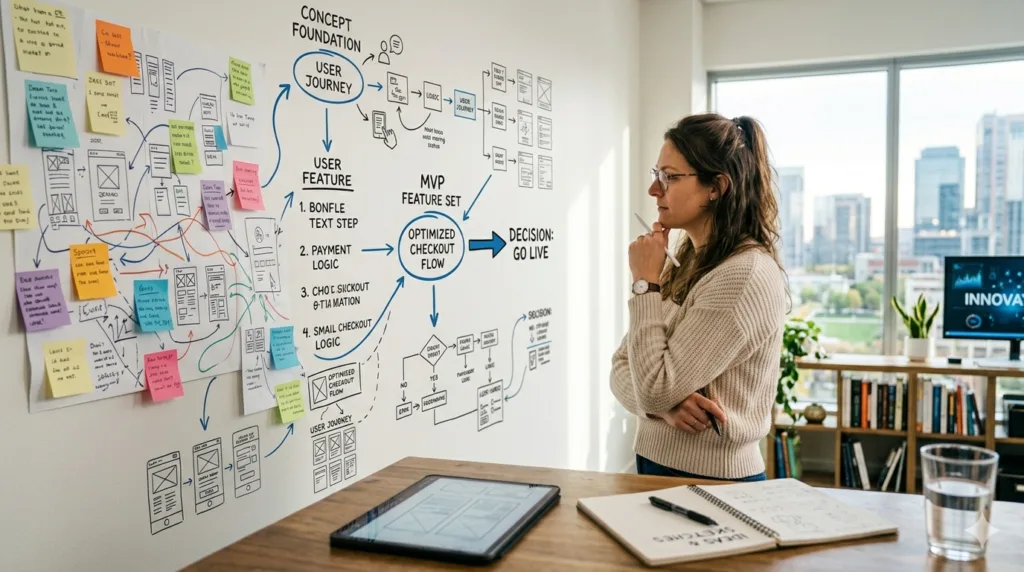
6. Ideas‑card – visually instead of just textual
The creativity not only in the Text, but also in the Image.
Therefore, I recommend:
- Create a mind map or a concept map for your topic.
- Use colors, Icons, Emojis, if you like.
- This Map will lead into a digital Tool (e.g., the Notion, Obsidian, Miro), and you link with your bookmarks.
Here you includes in your article "Bookmarks and Hyperlinks: Your digital knowledge“ to – here I show, how you use Hyperlinks that make sense and systematically to link your ideas.
7. Micro‑experiments – almost without risk
Lots of ideas to die, because they are meant to be big.
Therefore: Most small versions.
- Choose an idea that you're in my head for weeks.
- A do it Mini‑Experiment – a maximum of 1-3 hours.
- Presenting the result (e.g., in social media, in a Blog, or a short email to trust people).
You realize:
- What works?
- What is not?
- What would you do differently?
These experiments are the perfect fit for your contribution "From idea to Innovation“ where are you, step by step to show how from small Tests to large projects.
8. Perspective "AI wizard"
Use AI not only passive, but as a thinking partner:
- Describe your Problem in a Tool like grok, or ChatGPT.
- Question: "What are the 5 unusual perspectives, we have not considered yet?"
- Take these answers as a stimulus words for your own Exercises.
Here, you can up your article "Creativity in the age of machines“ as a Further reading reflekti link – there you are, how do you stay human, if AI takes over the computational work.
9. Excursion to the "foreign" world
Creativity often arises at the border to other areas.
Therefore:
- Visits to a completely different site, a different Medium, a different Format.
- Analyze what you can find there in a different way: structure, color, sound, interaction, Storytelling.
- Write 3 principles you in your area can do.
Example:
A post like "Creativity techniques at a Glance“ (external Link) offers many technical approaches, with your own artistic and educational experience associate can.
10. Reflection – why you want to be creative
At the end of such Exercises, I always ask:
- "What do I do that?"
- "What identity I will show my creativity?"
- "How it's changed my relationship to my ideas?"
A suitable anchor is mier your article "Creative Blockages“ – there, I reflect, as perfectionist thinking, time pressure, and digital distractions your creativity block.
Leave a Reply