 Skip to content
Technology, Art & We Will
The future of the space is already there
What happens to us if the screen disappears, and the world itself is to the surface?
This is exactly the threshold we stand Spatial Computing: a Form of computer use, in the case of the digital content not on a Monitor, but in our physical space. This is more than just a new Interface. It is a cultural Shift. And who wants to changed ways of understand why this development, our work, art and thought, should also have a look at Creativity and AI 2026 throw, because that's where it becomes clear how strong technology and identity access each other.
The real question is whether this technology is, but how we want to with your life. According to the latest Spatial Computing research AR, VR and spatial Interfaces to merge increasingly to a new Form of digital interaction, which combines physical and digital reality more closely.
The screen was just a crutch
The classic Monitor has long been a practical compromise. He helped us to make data visible, though our capacity for Thinking does actually, a lot of spatial. Just the power of Spatial Computing is so exciting: It solves the information from the rectangular cage of the display, and brings you into a space that we understand intuitively.
In my post The future of work: creativity and Innovation in the changing worlds of work is already visible, as work environments change, if flexibility, creativity, and new digital tools come together. That is exactly where this article is linked.
This is also from a design point of view is relevant: If the Information is no longer displayed, but spatially experienced a change in perception, focus, and ability to act. The result is not automatically more freedom – but it's definitely a different kind of freedom.
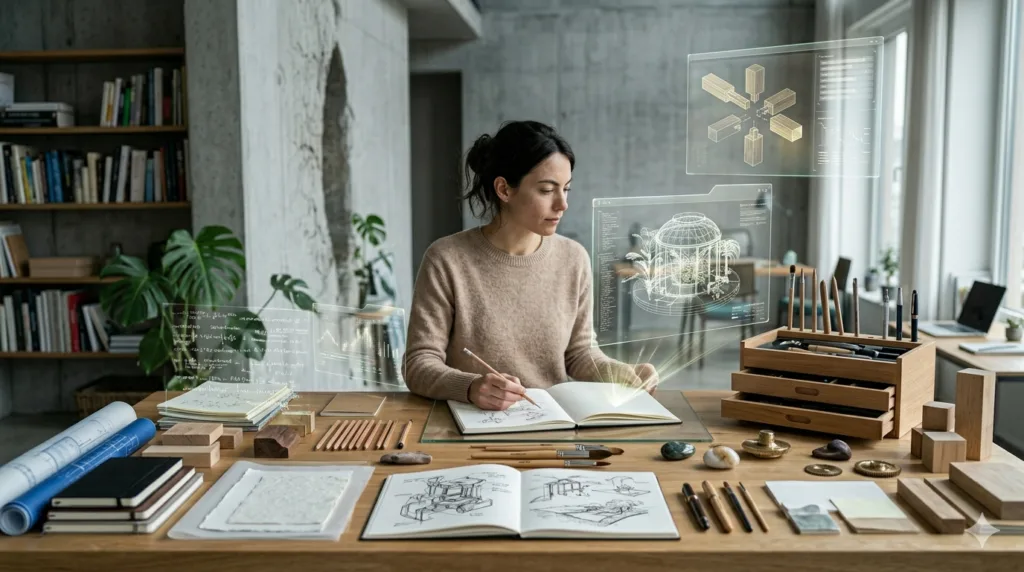
Art leaves the frame
In my artistic work on artist.Roland wegerer.at I have dealt with the question of how perception changes when the Medium itself is part of the content. This is exactly why Spatial Computing fits in so well, media art and installations. Especially the connection are capable of here Installation Archives and Works on paperbecause they show how different Material, space, and the idea of react with each other.
My article From the anvil to the 3D-lab provides a strong content-anchor: He describes how technological tools and creative processes, not to replace, but can expand.
Mnemonic:
The larger the digital space is, the more important the question, what are You You in this orientation only.
Practice exercise: space consciously curate
Spatial Computing can inspire or overwhelm. The difference mostly lies not in the technology but in the design.
- Real materials to put on Your table: wood, paper, stone, cloth. It keeps You physically in the room.
- Unlock digital levels be aware of if you have no more value. Not every piece of Information worthy of visibility.
- You may move to Think. Go to ideas around, instead of you staring only at the front.
- Reducing visual stimuli, if You want to focus on your work. A clear space often produces clearer thoughts.
This attitude fits well Focus in the stimulus floodbecause there is also the question of how You stay in an overloaded world mentally capable of action.
Who controls Your space?
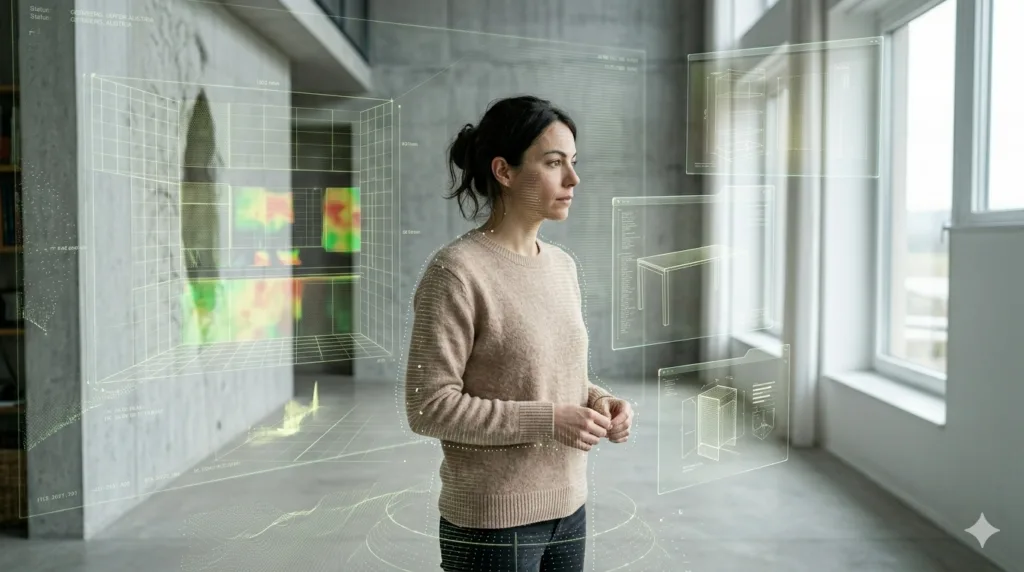
The space is not only creativity, but also the power of questions. If goggles, Sensors, or other systems that capture our space permanently, the result is a delicate question: to Whom this spatial Information actually belongs?
This is exactly where the issue is Spatial Privacy relevant. What sounds great in theory, according to convenience, may lead in practice to a very intimate data to a digital Image of Your living room. Around the development of devices such as the Apple Vision Pro shows very clearly how quickly a Vision of technology.
For this debate the perspective of The mit Media Lab Fluid Interfaces valuable, because there for years to Interfaces that human perception does not only use, but to think. This is fascinating and at the same time a reference to the fact that we are not allowed to talk about design, ethics, and control at the end of the development.
Between freedom and pressure
Spatial Computing can extend Your working area. You can store information about where they are useful, 3D models intuitively move and contents of spatially organize. At the same time can be a new Chaos: a boundless space without a focus, in which everything is at the same time is important.
That's why it needs a new Form of design competence. Not only in Design, but also in everyday life. Who dominates the space, does not mastered the technique, but he or she remains dominated by it.
This includes your article fits Regnose: A look back from the futurebecause it shows how helpful the future scenarios to make today better decisions.
The resolution: The main space inside
The real question of this article is not whether we'll soon live in a glass ball. It is as follows: How much the inner guidance You need in order to stay in a spatially extended world with You?
Spatial Computing is not an escape from reality. It is a new stage for perception, work, and art. But the depth of this stage is caused not by the technology itself, but by Your attitude, Your focus, and Your ability to distinguish the Important from the unimportant. There's also a healthy amount of is Stoicism 2.0 in this future, so valuable.
Conclusion: 'll designers to space
The future is not flat. It is spatial, smarter, and considerably more challenging. The more important it is that You're not just a Consumer of this development, but a designer.
Use Spatial Computing to expand perspectives. But don't forget to also maintain the real space in which You live, work and think. The best technology is of little use, if You lose Yourself in it self.
What is Your ideal digital work space would be? Write it in the comments and discuss with me how much space technique in Your everyday life really should get.
Next post in the series: Part 3: Digital sovereignty – Why Your data is Your art.
Leave a Reply