 Skip to content
Why doesn't your solution, although it would be logical?
You've identified the Problem, a solution is developed, implemented and still it comes back. Probably the Problem is not where you think. You only solves the symptoms, not the root.
It is precisely here that the sets Ishikawa Method also known as Fishbone Diagram or Cause-And-Effect Diagram. It is a fundamental tool in quality management and problem solving, forcing Teams to a systematic, in-depth and the actual roots of a problem to uncover. The KVP Institute GmbH she describes it as a basic quality management-a tool for systematic analysis of causes.
As someone who works daily with lesson problems, project irritation and creative blockages, I have integrated the Ishikawa method already in my tool kit. It combines perfectly with the S. P. A. L. T. E. N. Method – particularly in the "how to Analyze“ where Ishikawa as an analysis technique is used.
"You can never solve problems with the same mindset that created it.“
— Albert Einstein
What is the Ishikawa method is actually?
The Ishikawa method is a visual representation for the identification of potential causes of a problem. It was developed by a Japanese scientist Kaoru Ishikawa At the beginning of the 1940s.
The diagram reminds in its graphic shape of a stylized fish:
- The "Spine“ the main arrow
- To the right of the "Fish head“ the Problem
- The "Bones,“ the main categories of possible causes
- In addition to bones, the Details are below causes
Why "Herringbone“?
The shape is chosen deliberately: it visualizes complex structures on the Basis of a systematic and complete investigation the causes of problems. Instead of random ideas to gather, forcing Ishikawa structuring.
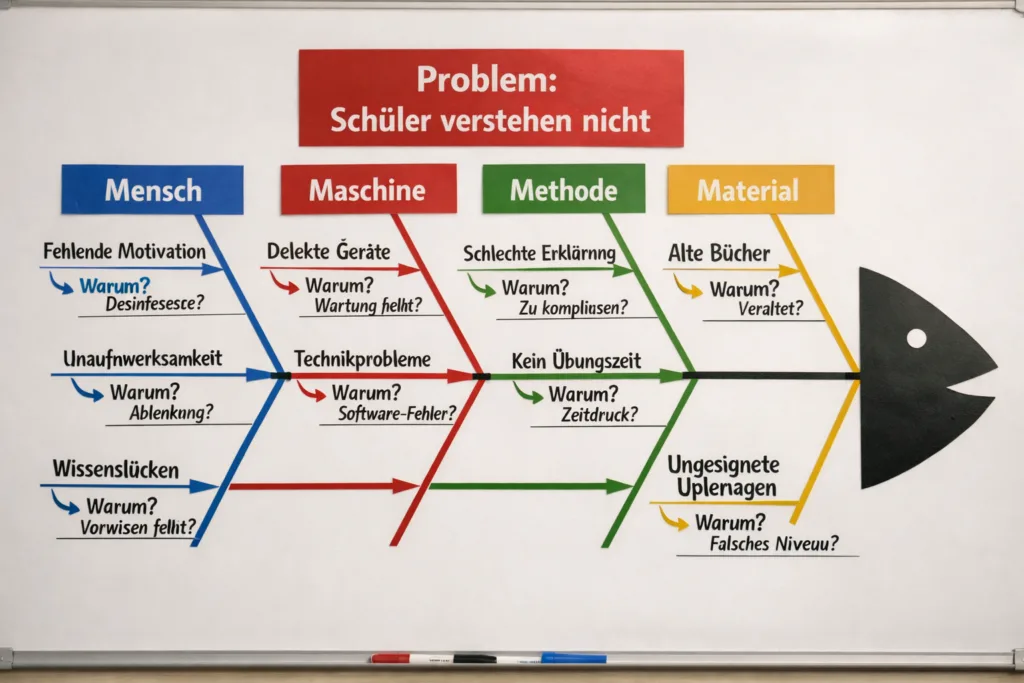
8M-categories: Your Category structure for the in-depth analysis
An Ishikawa diagram is typically built up with the main categories. The classic variant is the 4M methodadvanced forms 6M or 8M:
| Category | What is examined | Example of teaching |
|---|---|---|
| Man | People, Skills, Motivation | Students fluid in the Declaration is missing |
| Machine | Technology, Equipment, Software | The projector is not working properly |
| Material | Resources, Tools, Content | Teaching material is incomplete |
| Method | Processes, Methods, Didactics | The teaching method does not fit |
| Measurement | Data, Control, Feedback | Error rate is not measured |
| Environmental | Space, air, outer conditions | The room is too loud/hot |
| Management | Management, Planning, Decisions | Schedule is unrealistic |
| Participation | Cooperation, Communication | The Team does not work together |
8M method is particularly used in Six Sigma projects and complex process analysis. In everyday situations, 4M or 6M enough.
In short: Ishikawa structured causes in the main influence factors, depending on the Problem chosen differently.
When you use Ishikawa? Areas of application at a Glance
The Ishikawa diagram can during the entire duration of the project to be used when looking for a Problem causes. The The Free State Of Saxony shows in his project management Guide that Ishikawa can be universally used in projects – from the simple error analysis to the complex process optimization.
Main areas of application:
| Area | A Concrete Example Of Use |
|---|---|
| Production | Troubleshooting in production processes, high reject rate |
| Quality management | Quality problems |
| Customer care | Causes of customer complaints to determine |
| Process optimization | Increase efficiency, maintenance, improve |
| Project management | Brainstorming in a Team, relationship braid visualize |
| Education/Pedagogy | Learning problems, analyze, didactics optimize |
| Personal Development | Own blockages, resilience-understanding problems |
Ishikawa is especially suitable as a Guide for the inclusion of previously undiscovered relationships in the team work. The Quality.de explains how to systematically analyze, causes, recognize and processes sustainably optimize. More on this in the Guide Problem-solving skills: nut crack and in the Ishikawa Archives for further examples.
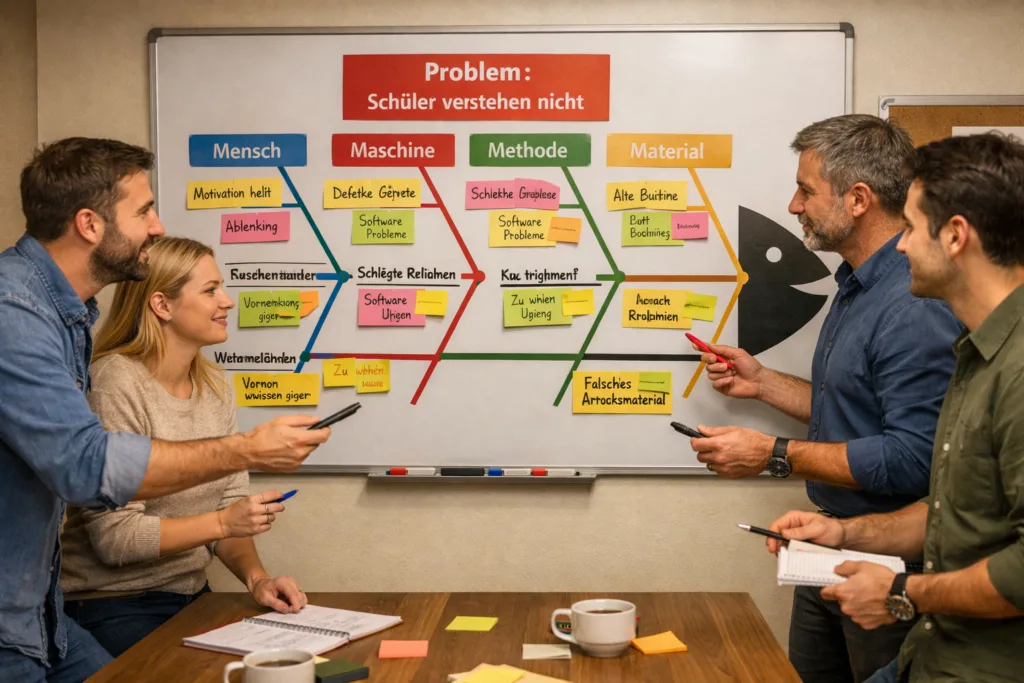
How you create an Ishikawa diagram? 4 steps to real cause
Step 1: preparation of the chart
- Sketch the Herringbone (Main Arrow + Bones)
- Make a note of each Bone a Main category (4M to 8M)
- Write the Problem specifically in the fish headImportant: The Problem must be precisely formulated. "Students are unmotivated“ is better than "it is not“ works;.
Step 2: causes of collect (Brainstorming)
- People will be in the Form of Creativity techniques the possible causes are elaborated
- In a Team Brainstorming session, collect all ideas
- No Blame – pure factsno "You did this“
Step 3: Ask! (The "Why“ Principle)
Here is the real depth to happen: question any cause, In addition to the causes of to find.
Example:
Cause: "students missing liquid“
→ Why? "Homework was not“
→ Why? "Time was not as“
→ Why? "Other Priorities (Sports, Family)“
This is the core principle: You go deeper and deeper, until you find the root.
Step 4: causes of rate & review
- Rate particularly relevant causes
- Optionally detailed this more
- Check: Are There Connections complete, coherent, consistent?
- Under search, content of all categories, before you're going to problem solving
The rule of thumb for judging: In the case of 25 causes-answers on a number of points = √25 = 5.
Practice exercise: Ishikawa in 20 minutes in the classroom or in everyday life
Target: A real Problem of your group/project with Ishikawa analyze.
Equipment:
- Whiteboard/paper or digital Tool
- Pens (various colors)
- Timer (20 Minutes)
Expiration:
| Time | Step |
|---|---|
| 0-3 min | Problem specifically, fish head)formulate ( |
| 3-5 min | 4M/6M/8M-categories of bones record |
| 5-15 min | Brainstorming: All causes collect |
| 15-18 min | Question: "Why?“ in the case of 3-5 Top causes |
| 18-20 min | Top 3 reasons to assess next steps, make a note of |
Tip: Use Ishikawa in step "of your Analyze“ S. P. A. L. T. E. N. Method – it is recommended to explicitly as a analysis technique.
Practice exercise: Ishikawa diagram use – man, machine, Material, method, environment, and measurement. No blame, pure facts.
Realistic example: Why does my statements in the classroom?
Problem (Fish Head): "Students are not“ understand my explanations;
| Category | Possible Causes |
|---|---|
| Man | Students have prior knowledge deficit; I'm going too fast |
| Method | Statement is abstract; no example; language too complex |
| Material | Teaching medium (projector) shows bad; Handout is missing |
| Environmental | The room is loud; heat; Seating is blocking view |
| Measurement | I'm not asking for understanding; no control |
| Management | The pressure of time; the schedule is too tight |
Question (at the Top cause "statement abstract“ a):
→ Why abstract? "I use technical terms without explanation,“
→ Why no explanation? "I think you already know it“
→ Why I think that? "I don't have your knowledge tested“
Root cause: "I'm not checking prior knowledge before the Declaration of“
Solution: Pre-Check insertion (5-min Quiz or questionnaire).
As this example shows, Ishikawa, not“ takes you from "students understand; not to know", I have checked“ the real root.
Ishikawa in the S. P. A. L. T. E. N. method: a Perfect combination
The Ishikawa method is not an isolated Tool – it combines strategically structured problem solving approaches. In the S. P. A. L. T. E. N. Method Ishikawa comes explicitly in step 3 (Analyze) to use:
| S. P. A. L. T. E. N.-Step | Ishikawa Reference |
|---|---|
| 1. Situation | Problem for the fish head is define |
| 2. Problem name | Precise Formulation |
| 3. Analyze | Ishikawa diagram |
| 4. Develop solutions | Based on Top-of-the causes |
| 5. Decision | Prioritization according to Ishikawa-assessment |
| 6. Transpose | Action against the root causes of |
| 7. Follow-up | Check if root is really solved |
This Integration of a power Ishikawa part complete problem-solving process – not just an isolated analysis tool.
Creative problem solver with 5 steps, Tools & Ishikawa, see the Ishikawa Archives for more examples.
Creative problem solver with 5 steps, Tools & Ishikawa.
Pros & cons: when Ishikawa shines and when it does not fit
Advantages:
| Advantage | Explanation |
|---|---|
| Systematically | Complete determination of all causes |
| Visually | Complex structures are clearly visible |
| Team-capable | Ideal for Brainstorming in groups |
| Depth | Forces to the Question ("Why not?“) |
| Universal | Not only manufacturing, education, everyday life, project |
| Blame-avoiding | Pure facts that no assignment |
Cons:
| Disadvantage | Explanation |
|---|---|
| Less complexity | Less suitable for nested complex networks |
| Time required | 20-40 minutes for real deep |
| Surface-Risk | If not questioned, it remains superficial |
| Categories-dependent | Choice of M-categories influenced the result |
Conclusion: Ishikawa is ideal for Initial reception of problem structuresfor detailed analysis of extremely complex systems.
Ishikawa vs. other methods: what is the difference?
| Method | The core difference Ishikawa |
|---|---|
| 5-What? | Focus on 5 questions, visually structured |
| SWOT | Analysis of Strengths/weaknesses, not cause-and-effect |
| Design Thinking | The creative process-not causes-focused |
| SCAMPER | Creative Tool, not a Problem-analysis |
| S. P. A. L. T. E. N. | The overall process, Ishikawa is part of it (step 3) |
Ishikawa is unique due to its visual cause-and-effect structure – that's what makes it so powerful.
Trend 2026: Ishikawa in AI-based processes
In the current AI and digitalization turning Ishikawa is increasingly in AI-based problem-solving processes integrated:
- AI Tools can generate Ishikawa diagrams automatically
- Data analysis Tools to extract the causes of large data sets
- Ishikawa is part of automated quality management systems
This connects with the theme Digital Authenticity: AI as a Turbo, but human attitude remains the steering Wheel.
Use AI for efficiency, but keep your human authenticity.
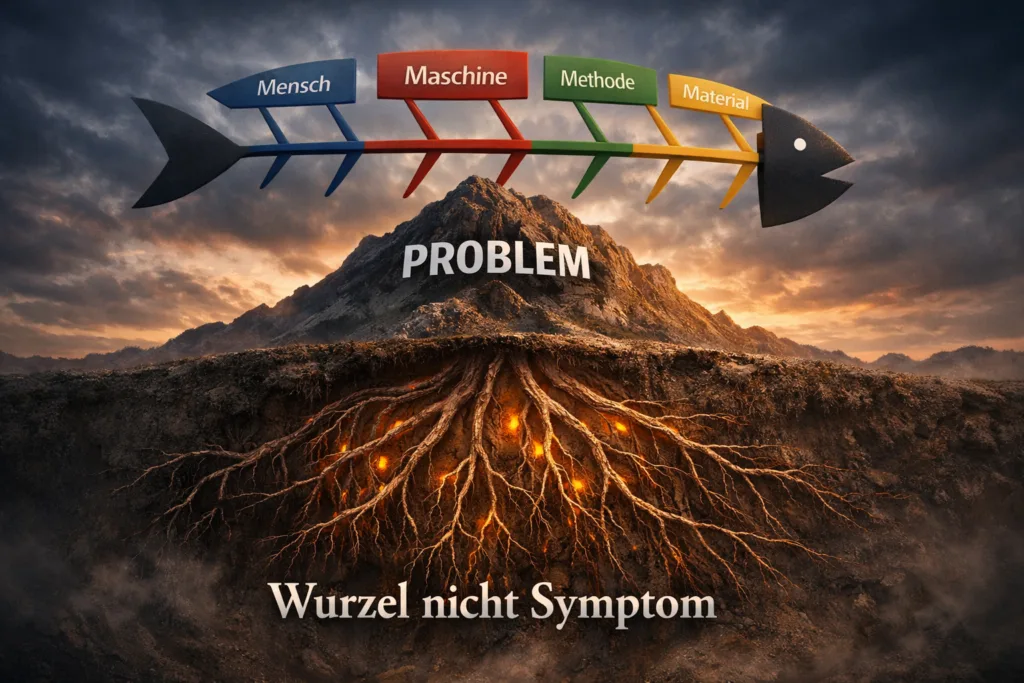
Next step: Ishikawa morning implement
Your task for tomorrow:
- Take a real Problem from your everyday life/lessons/project
- Sketch on paper Herringbone (Main arrow + 4M-categories)
- Formulate the Problem in the Fish head precise
- Collect 10-15 Causes (Brainstorming, 5 Minutes)
- Question 3 Top causes "Why not?“ (3 levels)
- Note a concrete measure against the root cause
Look also to the Glossary Creativity & Methods for more Tools and terms. Check out my art at artist.Roland wegerer.atwhere interdisciplinary creativity with scientific and economic Insight merges.
After-Effects Of Thought:
Maybe the Problem is not where you think. Maybe you need to dig deeper – and the herringbone shows you the way.
FAQ: Ishikawa method – 5 frequent questions
1. What is the difference between Ishikawa and fishbone diagram is?
There Is No Difference. "Ishikawa-diagram,“ and the "fishbone diagram,“ are synonymous – both refer to the same cause-and-effect diagram.
2. How many categories should I use?
For Everyday Life/Lessons: 4M (Man, machine, Material, method) is sufficient. For complex processes: 6M or 8M (plus measurement, environment, Management, and participation).
3. Can I make Ishikawa alone, or it needs a Team?
Ishikawa works both. As an individual: your own reasons, collect. Team: Brainstorming brings more perspectives.
4. How long is an Ishikawa diagram take?
For a simple Problem: 15-20 minutes. For complex problems with deep questions: 30-45 minutes.
5. Ishikawa is only for quality management or also for everyday life?
Ishikawa is universally applicable: Production, education, everyday life, project, personal development. It is not a pure quality management Tool.
CTA:
You have a Problem that comes up again and again? Try Ishikawa morning and find the root, not the Symptom. Share your experience in the comments or link to this article with someone who needs to solve problems.
See also Innovation & The Future for skills, KI, creativity & Tools, or Error culture instead of perfection trap for the courage to be imperfect.
After-Effects Of Thought:
The true solution lies deeper than you think. The herringbone shows you the way.
Leave a Reply